Loading...
Skip to Content

When accountability sits with you

Are you sure

Does this feel familiar?

You’re accountable for outcomes, not just delivery.

Your name is attached to decisions, not just recommendations.

You’re living with a sense of unease that won’t go away.

You have enough autonomy to act when something doesn’t feel right. And you’re expected to use it.

You know this script, and where it can lead.
If it does, it lands with you.

When Unease is Greatest

Your gut tells you to take notice

It’s the uncomfortable sense that something is off, and you wouldn’t be able to defend why. You recognise it when:

  • Performance is strong, but you can’t explain why it's strong.
  • Nothing has gone wrong for a while, and that starts to feel uncomfortable.
  • Change is happening faster than your understanding of its implications.
  • Controls look complete on paper, but you haven’t seen them tested under real conditions.
  • A near miss felt lucky.
  • You realise you are relying on competence, goodwill, or heroics instead of design.
  • You can’t tell whether the silence in the system means stability or blindness.
  • You’re about to sign something that carries your name.

This isn't panic, it's pattern recognition. You need a grounded view of whether things are actually under control.

unwanted causal chain

Do you really understand what happened?

Attention is now on your decisions, and on the basis for them.

Emotions are high. Consequences are real. The pressure is on.

Explanations are already forming, but certainty is missing. You don’t want this repeating, and stakeholders expect it won’t. Without a clear, rigorous understanding of what really happened, you are exposed to it happening again.

You need to know how this happened.

Not reassurance. Not stories. Evidence.

What matters now is stabilisation, disciplined focus, truth, and a way forward grounded in reality.

Event analysis and control performance

You already know what won't fix this

Asking people to try harder, without understanding the drivers of performance.

Pre-packaged programmes before reality is understood.

Tick-box assurance. Paperwork instead of confidence.

Advisory theatre, foregone conclusions.

Self-preserving, open-ended engagements.

Specialists who arrive with answers and leave before clarity is established.

From Unhealthy Unease to Grounded Confidence

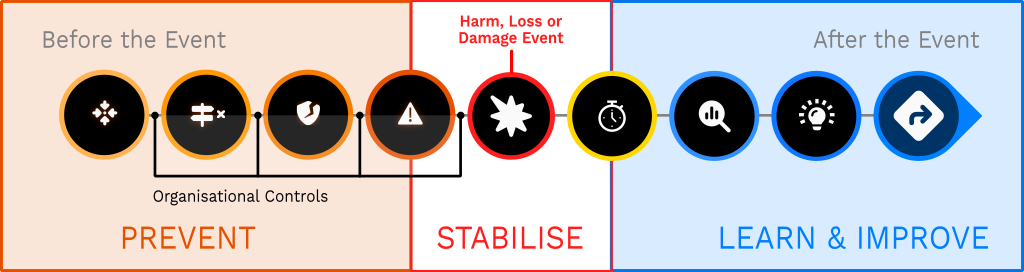
Calm first. Then Control.

Diagram: from unhealthy unease to grounded confidence

The unease you are feeling is not weakness. It's information.

When performance looks strong, there are usually only three explanations: luck, problems being suppressed, or systems deliberately designed to produce the outcomes you want.

Only one of those is healthy and sustainable.

Resolving unease requires examining what success is built on, and the conditions that shape behaviour, particularly when nobody is watching. Then making success deliberate. Predictable. Sustainable.

The way forward is not around discomfort, it is through it. You don’t have to walk that path alone. But you do have to face into it.

Progress rarely comes from doing more. It comes from seeing clearly, deciding deliberately, and acting precisely.

Where Independent Support Makes the Biggest Difference

Operational Reality and Drift

An objective view of how work is actually carried out, and how it may have slowly changed over time.

Causal Chain Integrity

Examining whether warning signs exist across the full pathway to failure, especially upstream where incidents are seeded.

Health of Organisational Controls

Assessing whether the controls relied upon are sufficient, resilient, and effective under real operating conditions.

Capability and Culture

Everyday behaviours, competence, and the human performance conditions that shape them, especially when nobody is watching.

Golden Hour Stabilisation

Preserving people, evidence, and context in the immediate aftermath, before truth is lost or distorted.

Independent Incident Investigation

Objective assessment of what happened, scaled to match seriousness and potential consequences.

Reconstructing the Causal Chain

Reconstructing how controls were weakened, bypassed, or absent across the full system.

Sense-Making Under Scrutiny

Supporting clear thinking and interpretation while under regulatory, board, or workforce pressure.

Calm first. Then Control.

What the first step looks like

We start with a short, structured orientation conversation.

This is a focused discussion, free of charge, designed to clarify what you are dealing with and whether focused support would genuinely add value.

The aim is not to diagnose problems or design solutions, but to answer a small number of important questions that often remain implicit or untested.

By the end you should have enough clarity to decide whether to proceed with some targeted work, pause, or take a different path altogether.

01 Shape sensing
We put form to the situation you are in.

Whether unease is emerging quietly beneath apparently stable performance, or whether something has already happened and confidence has been disrupted.

This matters because different shaped scenarios demand specific responses, and treating them the same is where organisations lose time and traction.

What you gain

Orientation when things feel unclear.

Relief from carrying unease alone.

Decisions grounded in reality, not hope.

Confidence built on evidence, not assertion.

Typical Engagements

Your Invitation

The first conversation is simply a chance to think out loud, without commitment or consequence.

Where you are now is enough to begin.

Sometimes the conversation is enough. Sometimes it clarifies the need for deeper work. Either outcome is a valid place to land.

Evolution Compliance and Management Solutions logo
© 2018 - Evolution Compliance and Management Solutions Ltd
All Rights Reserved
Registered Company in England and Wales 10340721